The warning signs
UF/IFAS Extension's publication "Is my tree safe?" opens with a plain statement: it is a landowner's responsibility to make sure the trees on their property are safe. It asks owners to look over the crown, the main branches, the trunk and the roots for seven conditions that raise the chance of failure.
- Dead branches. Loose bark and dead or missing leaves. Large dead limbs high in the tree are the biggest concern.
- Broken or hanging branches. These have already failed and can drop even on a calm day.
- Codominant stems. Two or more stems of similar size rising from one point, especially with a tight V-shaped union.
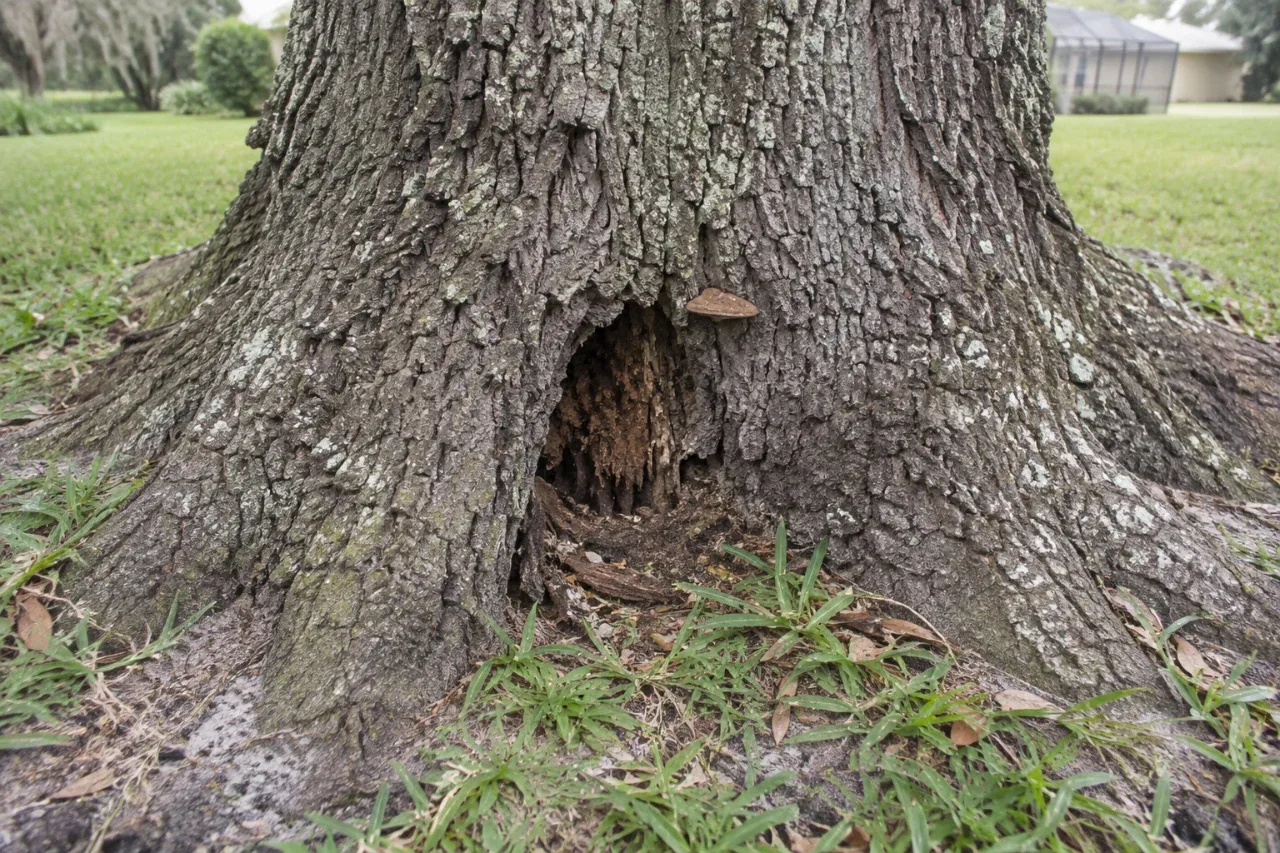
- Decay. Fungal conks or shelf fungus, carpenter ants and animal nesting holes point to rot inside.
- Cavities. Usually where the tree was injured or badly cut in the past.
- Leans. A lean that is getting worse quickly, or one with the soil heaving up on the far side of the trunk, should be treated as high risk and looked at right away.
- Root problems. Thinning or dying crown, mushrooms at the base, swelling at the root collar, and broken or exposed roots.
Not every flaw means the tree has to go. UF/IFAS's Gardening Solutions notes that sometimes only the damaged parts need to be removed, and that corrective pruning or cabling can lower the risk. Whether that's realistic depends on the tree, so have it looked at.
Hollow laurel oaks
Laurel oak is a tree worth watching as it ages. UF/IFAS's species fact sheet gives it a life span of 50 to 70 years, says the tree hollows with age as it approaches 50 years old, and notes that trunks and large branches often hollow from decay and wood rot. It adds that a small trunk injury or a poor pruning cut can start a decay column 10 feet long or more. In UF/IFAS's wind studies, laurel oak sits in the lowest wind-resistance group. See Palm Coast trees and storms.
Pines that turn brown
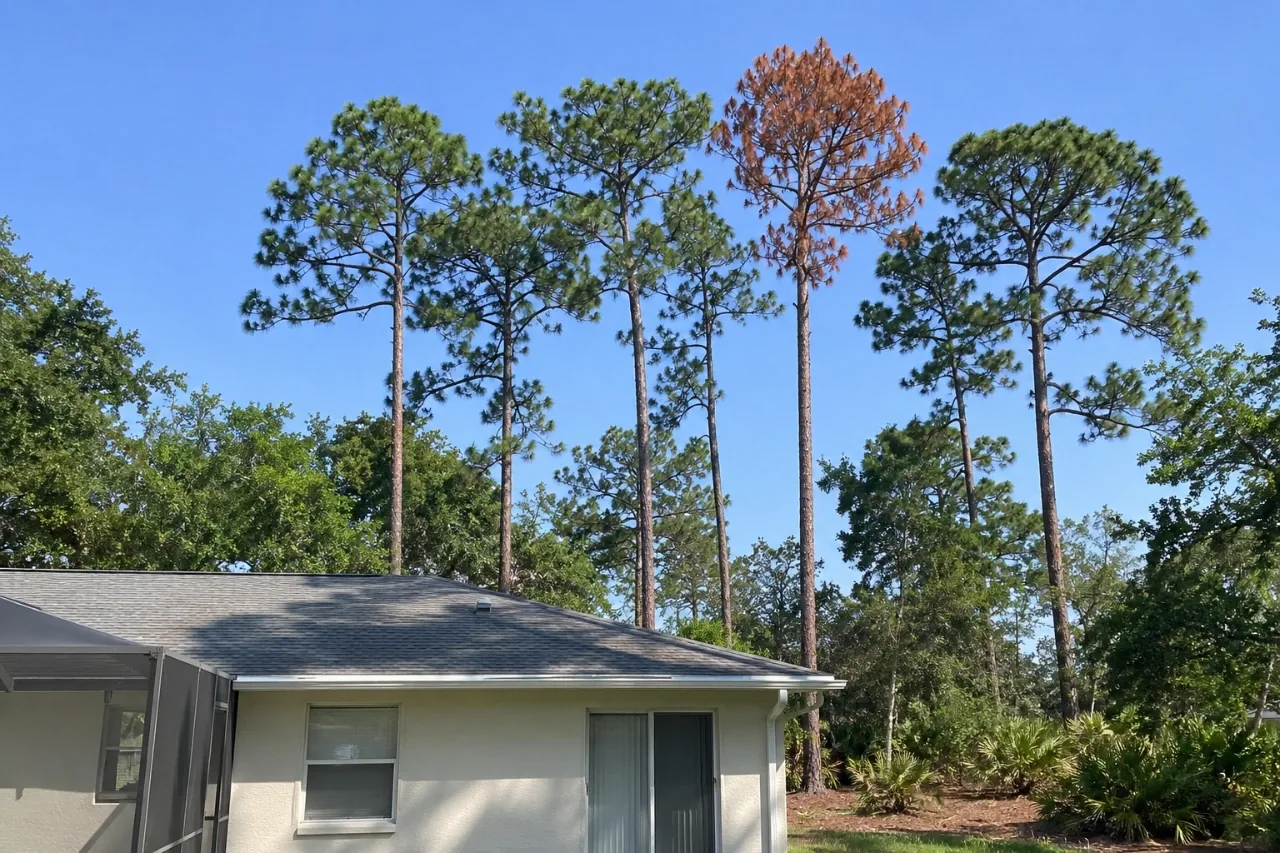
A pine that fades from green to yellow to rust-brown has often been hit by bark beetles. The Florida Forest Service's forest health section describes how it goes after a hurricane: Ips engraver beetles and black turpentine beetles go after stressed, damaged and dying pines, including trees that look intact but have hidden root or internal damage. After Hurricane Michael in 2018, Ips killed many pines that bent in the wind rather than broke.
- Pitch tubes. A small blob of resin with a hole in the middle is often the first visible sign of an attack on a living tree.
- Boring dust. Fine dust in the bark crevices, common on pines that Ips beetles have killed.
- A fading crown. Needles turn yellowish, then brown. This is often the last sign to appear, after the beetles have already left.
Activity is especially likely in the year after a storm. For Ips and black turpentine beetles, the Forest Service says removing infested trees isn't critical for controlling the beetles; the reason to take out a dead pine is the risk of it falling on people or property. A dead pine near a house, a driveway or a street is that kind of tree.
When the city approves a hazard removal
A permit is still the normal route in Palm Coast, but section 11.02.05.E of the city's code lists the situations where the Land Use Administrator can approve removing a protected tree on a developed lot:
- Dead, severely diseased or severely injured trees, as determined by the city's Land Use Administrator or an arborist meeting the code's terms.
- Trees posing an imminent danger to public health, safety and welfare that standard methods can't correct.
- Trees creating a sight distance problem along a public right-of-way.
- Any pine within 30 feet of a structure, or closer to it than the tree is tall, as a safety precaution, with the owner's agreement and an application.
- Trees causing structural damage to a foundation, driveway, patio, wall, or water or sewer line that standard methods can't correct.
Apply through Building Services at (386) 986-3780, which also takes questions about hazard trees and inspections.
The state law on risky trees at homes
Florida Statute 163.045, created in 2019 and amended in 2022, limits what a city can require for a tree on residential property, meaning a detached single-family home on a lot used that way. If the owner has documentation that the tree poses an unacceptable risk, the city may not require a notice, application, approval, permit, fee or mitigation to prune, trim or remove it, and may not require the owner to replant.
The statute defines both terms. The documentation is an on-site tree risk assessment done under the International Society of Arboriculture's best management practices and signed by an arborist or landscape architect who meets the statute's requirements. A tree is an unacceptable risk when removing it is the only practical way to bring its risk below moderate. Read the full statute before relying on it. This site doesn't give legal advice.
A neighbor's dead tree
If a dead or leaning tree on the next lot threatens your house, talk to the owner first. If it later falls, the Insurance Information Institute said in 2010 that the claim goes on your own policy, and your insurer may pursue the neighbor's insurer, especially if the tree was in poor health. For a hazardous tree on a vacant private lot, the city's storm guidance says it can issue a notice to remedy and, if the owner doesn't act, remove the tree and bill them. Customer Service is at (386) 986-2360.
What commonly goes wrong
- Waiting for the next storm. A fast-growing lean or heaving soil calls for an inspection right away.
- Judging by leaves alone. UF/IFAS warns that leaves or their absence don't prove whether a tree is alive or dead.
- Climbing a dead tree. Dead wood is brittle. Ask how the contractor plans to take it down.
- Assuming the risk law covers everything. It needs the documentation the statute describes, and it applies to homes, not vacant lots.
Questions homeowners ask
My pine turned brown in a few weeks. Is it dead?
A crown that fades quickly often follows a bark beetle attack, and by the time the needles are brown the beetles have usually moved on. Have it looked at. A dead pine near the house is a removal to plan soon.
Is a leaning tree always dangerous?
Not always. A tree that grew at an angle over many years may be stable. One that started leaning recently, or shows soil heaving at the base, is high risk by UF/IFAS's account.
Can I remove a dead tree without a permit?
In Palm Coast, apply first: dead and severely injured trees are grounds for approval under the city code. The state law on risk documentation is a separate path for homes.
Who decides if a tree is a hazard?
The city's code gives that call to its Land Use Administrator or an arborist meeting the code's terms. Under the state law, the documentation comes from an arborist or landscape architect meeting the statute's terms.
This site passes your request to one independent local contractor. It does no tree work itself.
- UF/IFAS Extension, "Is my tree safe? Recognizing Conditions that Increase the Likelihood of Tree Failure" (ENH1246/EP507, reviewed 2018); Gardening Solutions, Tree Risk Assessment; Quercus laurifolia: Laurel Oak (ST549, revised 2018).
- Florida Forest Service Forest Health Section, post-hurricane bark beetle guidance (2025).
- City of Palm Coast Unified Land Development Code 11.02.05; storm debris and tree guidance, October 3, 2022.
- Florida Statutes section 163.045 (2026). Insurance Information Institute, guidance on fallen trees (2010).