
Which trees need a permit
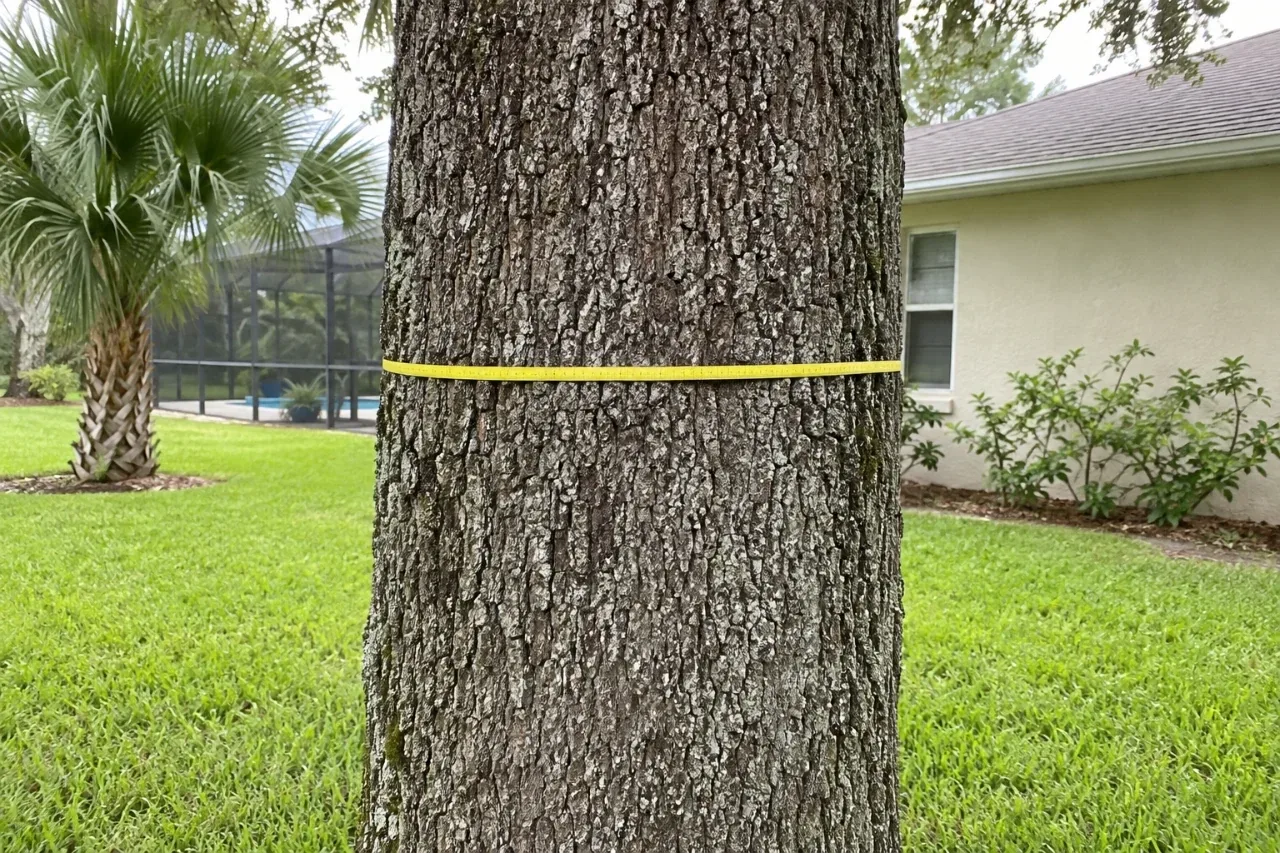
The city's help center answers it in one line. Any tree whose trunk measures at least 6 inches in diameter, taken four and a half feet above grade, needs a permit before it is cut down or removed, and the same goes for damaging or destroying it by pruning. For a tree that was surveyed for credit, the threshold is 4 inches.
The code doesn't define "surveyed for credit" on the pages read for this site. It generally refers to trees counted toward a lot's required trees. Ask Building Services whether yours were before assuming the 6-inch line applies.
Two things trip people up. The trunk is measured at four and a half feet, not at the ground, where it flares out wider. And the rule includes damage by pruning, so an over-pruned tree can be treated like a removed one; see tree trimming.
Protected, specimen and historic trees
| Category | Trunk size at 4.5 feet | What it means |
|---|---|---|
| Protected | 6 inches or more (4 inches if surveyed for credit) | A permit is needed to remove it. Invasive and unsuited species are excluded. |
| Specimen | 24 inches or more, or smaller for some species, such as 18 inches for oaks and 12 inches for cypress; sand pines are excluded | Removal on a developed lot means planting one shade tree |
| Historic | 36 inches or more | Removal on a developed lot means planting two trees, at least one a shade tree |
These categories come from section 11.02.01 of the city's Unified Land Development Code, as posted in Ordinance 2016-6, and the city's single-family landscape summary. The city has been reworking Chapter 11 of its code, so ask Building Services at (386) 986-3780 whether the tree code has changed before you rely on these numbers.
When no permit is needed
- Removing an invasive plant species listed under the state's noxious weed rule.
- Tree work in or around an existing city or utility easement done by or for the utility.
- Removing trees on platted single-family and duplex lots that a utility has already cut back severely.
- Pruning, as long as it follows the ANSI A300 standard and doesn't amount to an effective removal.
The code also lets the Land Use Administrator suspend the tree removal requirements during a declared emergency. That is a decision the city announces; it isn't automatic after every storm.
What the lot owes after a removal
Every single-family lot must keep a minimum number of trees: one for every 2,500 square feet of lot area, or major fraction of it, not counting ponds, lakes and canals. A 10,000-square-foot lot needs four. The lot also needs a minimum number of shade trees: one on any lot, two from a third of an acre, three from two-thirds of an acre, and four at an acre or more.
How a removal plays out on a developed lot
- The lot has more protected trees than its minimum. One of the extras, other than a specimen or historic tree, can come out with a permit and no replacement.
- The removal drops the lot below its minimum. The tree must be replaced.
- It's a specimen tree. One shade tree goes in.
- It's a historic tree. Two trees go in, at least one of them a shade tree.
Replacement shade trees are planted at 2-inch caliper. Clusters of three palms, each with 3 feet of clear trunk, can replace up to half of the required shade trees, but at least one shade tree is still required.
Dead, dangerous and damaging trees
Section 11.02.05.E of the code lists the grounds on which the Land Use Administrator can approve removing a protected tree on a developed lot after an application: dead, severely diseased or severely injured trees; trees posing an imminent danger that standard methods can't correct; trees blocking sight distance along a public right-of-way; any pine within 30 feet of a structure, or closer to it than the tree is tall, as a safety precaution, if the owner agrees and applies; and trees causing structural damage to a foundation, driveway, patio, wall, or water or sewer line that standard methods can't fix. See dead or leaning trees for the warning signs.
The state law for risky trees at homes
Florida Statute 163.045 limits local permits for trees at homes. On residential property, meaning a detached single-family house on a lot used as one, a city may not require a notice, application, approval, permit, fee or mitigation to prune, trim or remove a tree if the owner has documentation that it poses an unacceptable risk, and it may not require replanting. The documentation is an on-site tree risk assessment under the International Society of Arboriculture's best management practices, signed by an arborist or landscape architect who meets the statute's requirements. The risk is unacceptable when removal is the only practical way to bring it below moderate. Read the statute itself; this site doesn't give legal advice.
What happens without a permit
- Each tree damaged or removed without approval is a separate violation of the code.
- Removed trees have to be replaced, with requirements that vary by property type.
- The Land Use Administrator can issue a cease-and-desist order.
- Where trees weren't surveyed, the fine the city sets applies.
- Uncorrected violations can be referred to the Code Enforcement Board, which can add fines.
How to apply, and who to call
Apply through the city's Building Services, at City Hall, 160 Lake Avenue, phone (386) 986-3780. The help center points applicants to the building pages on the city's website. Building Services also takes questions about tree rules and inspections. General questions go to Customer Service at (386) 986-2360 or PalmCoast.gov/Connect.
You won't be the only one applying. By our November 6, 2026 count of the city's permit search, it issued 1,279 tree removal permits in 2024, 957 in 2025 and 846 from January 1 to November 5, 2026, and the owner was listed as applicant on 761 of those 846. Settle in writing whether you or the contractor will apply, and schedule the work for after approval.
Outside Palm Coast city limits
These rules are the City of Palm Coast's. Flagler Beach, Bunnell and unincorporated Flagler County write their own. Flagler County Growth Management: (386) 313-4003. City of Bunnell Community Development: (386) 437-7516. City of Flagler Beach Planning and Building: (386) 517-2000, then press 3 for the Building Department. Ask before any tree comes down.
Questions homeowners ask
Is a permit needed for a tree that's already dead?
Apply first. Dead and severely injured trees are listed grounds for approval, so the application should be straightforward, and the state law on risk documentation is an alternative for homes.
What does the permit cost?
The city pages read for this site don't list the fee. Building Services at (386) 986-3780 can give you the current amount.
Does trimming need a permit?
No, but the pruning must follow ANSI A300, and topping, lion-tailing, hat-racking or raising the canopy above a third of the tree's height counts as effective removal.
Do palms count?
Palms count toward a lot's required shade trees in clusters of three. Ask Building Services before removing palms that may have been counted. See palm removal and trimming.
This site passes your request to one independent local contractor. It does no tree work itself.
- City of Palm Coast help center, "Do I need a permit to cut down a tree?" Read November 2026.
- City of Palm Coast Unified Land Development Code Chapter 11, as posted in Ordinance 2016-6, and the single-family landscape requirements summary. The code in force is on Municode.
- Florida Statutes section 163.045 (2026).
- City of Palm Coast permit search, type TR (Tree Removal), our count by issue date, November 6, 2026.