
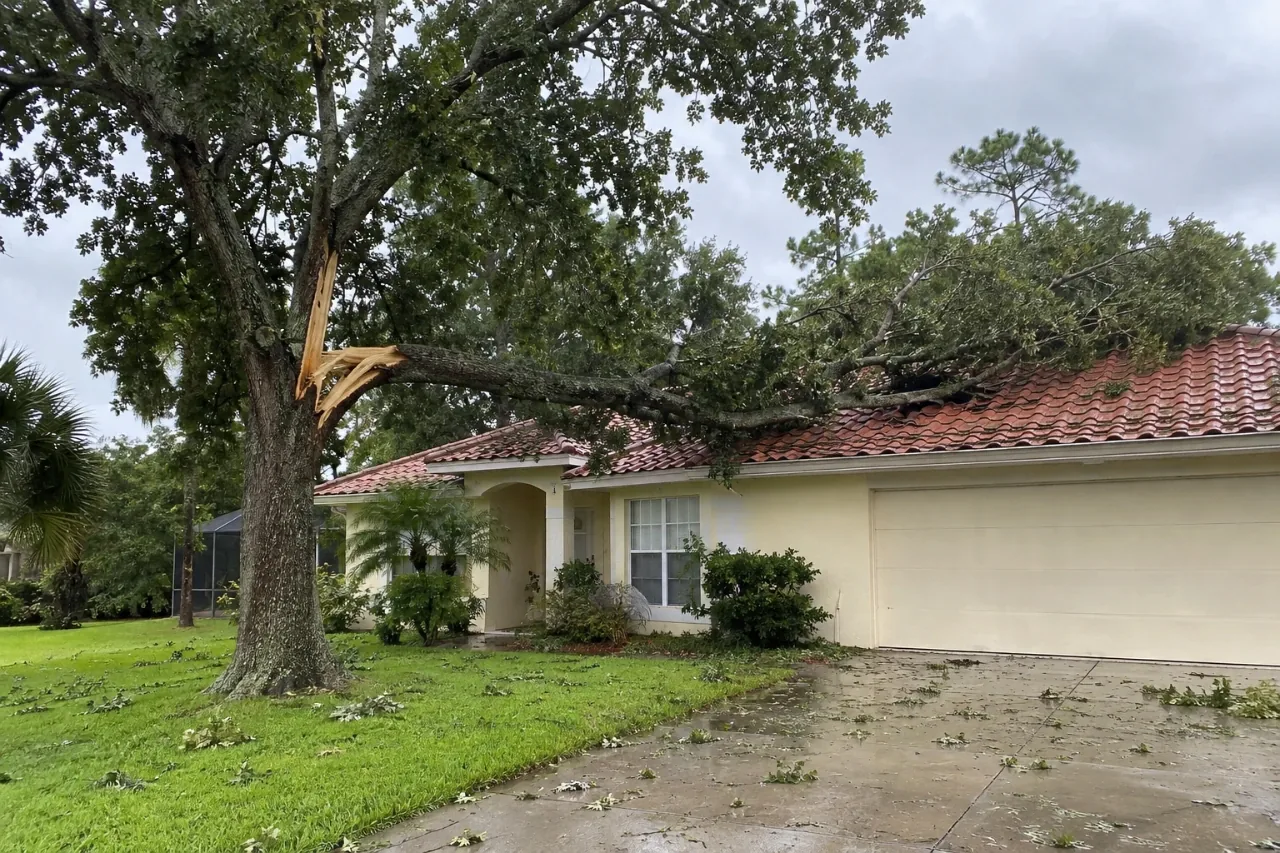
Why fallen trees are an emergency
Trees kill people in windstorms. A study in the journal Natural Hazards counted 407 deaths in the United States from wind-related tree failures between 1995 and 2007. Of those, 44 percent were in vehicles struck by a tree or driven into one lying on the road, 38 percent were outdoors, and 9 percent each were inside mobile homes and frame houses. Victims of tropical cyclones and tornadoes were far more likely to be at home when it happened, 40 percent of them, than victims of thunderstorms and other high winds, at 13 percent.
Northeast Florida has seen it close up. The National Weather Service's summary of Hurricane Matthew in October 2016 records gusts of 76 and 83 mph measured at Flagler Beach and trees uprooted in Palm Coast by noon on October 7. The one death that summary describes, a woman killed by a falling tree, happened in neighboring Putnam County.
First steps when a tree comes down
- Get everyone out of the rooms under the tree. A trunk resting on a roof can shift as the wind keeps blowing or as branches are cut.
- Treat every wire as live. FPL says to stay far away from downed lines, assume all cables and wires are energized, and keep clear of flooded or debris-covered areas that can hide them. Report downed lines to FPL at 1-800-4OUTAGE (1-800-468-8243), or call 911.
- Don't cut wires tangled in the tree. Sunshine 811 warns not to cut above-ground lines running through trees or on the ground, because they could still be live, and to check root balls for buried lines before cutting near them.
- Take photos before anything moves. Shoot the tree, where it came from, the damage to the roof, walls, fence and car, and the inside of the house if water is coming in.
- Call your insurer. Ask what they need before the tree comes off the house.
- Then arrange the removal. Lifting a tree off a roof without causing more damage is skilled work. Describe exactly what is resting where when you call.
Who removes which tree
The city laid out who is responsible in its storm guidance after Hurricane Ian in October 2022:
| Where the tree came from | Where it landed | What the city said |
|---|---|---|
| City property, such as the right-of-way | Your private property | Submit a ticket at PalmCoast.gov/Connect so the city can inspect and determine the removal process |
| Your property | Your property | The owner is responsible |
| A neighbor's developed lot | Your property | A civil issue between the two owners, who are responsible for removal |
| A vacant private lot | A hazard to others | The city can issue a notice to remedy, and if it isn't removed in time, remove it and bill the owner |
Questions go to Customer Service at (386) 986-2360 or through PalmCoast.gov/Connect. Procedures can change from storm to storm, so check the city's announcements after each one.
How insurance usually handles fallen trees
The Insurance Information Institute described the common pattern in standard homeowners policies in 2010:
- A tree knocked onto the house by a covered peril such as wind is generally covered for the damage to the structure and contents. Coverage to remove the tree itself is generally around $500 to $1,000, depending on the insurer and the policy.
- A tree that falls in the yard without hitting a structure usually isn't covered for removal, though some insurers pay to clear a tree blocking a driveway or a ramp.
- A neighbor's tree on your house is still a claim on your own policy. Your insurer may then go after the neighbor's insurer, especially if the tree was in poor health or poorly kept.
Every policy is different, deductibles included. Read your declarations page, ask your agent, and keep every invoice and photo. A contractor can't decide what your policy covers.
Storm debris at the curb
After a storm the city runs its own debris collection and announces the rules for it. In the 2022 guidance, vegetative debris was to be placed near the road in the city's right-of-way, and the city's hauler took debris under 2 cubic yards per home, with city crews handling larger piles. After the 2024 storms, the city collected vegetative debris on a first pass and construction and demolition debris on a second.
Outside a declared storm cleanup, the city's ordinary yard-waste limits apply, and its September 2024 notice says lawn services and tree trimmers must haul away the waste they create. When you hire storm work, ask whether the quote includes hauling or whether the crew will stack brush for city pickup, and keep vegetative debris separate from roofing or fence material.
Permits after a storm
The city's code lets the Land Use Administrator suspend its tree removal requirements during a declared emergency. Don't assume a suspension is in effect: watch the city's announcements, and photograph a damaged tree before it's removed. Dead, severely injured trees and trees posing an imminent danger are on the list the city can approve for removal in ordinary times, and Florida Statute 163.045 lets the owner of a single-family home remove a tree without a city permit when documentation shows it is an unacceptable risk. See the permit guide.
Price gouging after a declared emergency
Florida's price gouging law, section 501.160 of the Florida Statutes, applies during a declared state of emergency and defines a commodity broadly to include services. Report suspected gouging to the Attorney General's hotline at 1-866-966-7226 or at MyFloridaLegal.com.
What commonly goes wrong
- Cutting before photographing. The insurer may want to see the tree where it fell.
- Working near wires. Lines can be live even when the power is out.
- Cutting a tree that's under tension. Bent trunks and limbs pinned under weight can spring when cut. Leave it to an experienced crew.
- Brush mixed with building debris. The city collects the two separately after storms.
- Signing for work with no written price. Get the scope, price and cleanup in writing even when it's urgent.
Who this guide isn't for
If the tree is standing but you're worried about it, see dead or leaning trees. If the storm passed and you want to get ahead of the next one, see tree trimming and Palm Coast trees and storms. If anyone is hurt or trapped, call 911 first.
Questions homeowners ask
Should I cut the tree off my roof myself?
No. A trunk resting on a roof is loaded in ways that are hard to read, and cutting it in the wrong order can drop it further into the house. Wait for a crew with the equipment to lift or lower it.
Will my insurance pay for removing a fallen tree?
If the tree hit an insured structure in a covered storm, removal is commonly covered up to a limit, often around $500 to $1,000, according to the Insurance Information Institute's 2010 guidance. A tree that only fell in the yard usually isn't. Check your own policy.
The tree came from the swale. Is it the city's?
Possibly. The city's storm guidance asks you to submit a ticket at PalmCoast.gov/Connect so it can inspect a tree that originated on city property and decide the removal process.
Do I need a permit to remove a storm-damaged tree?
Ordinarily yes, though dead and dangerous trees are grounds for approval, the city can suspend its requirements in a declared emergency, and the state law on risk documentation applies to homes. Call Building Services at (386) 986-3780 if you're unsure.
This site passes your request to one independent local contractor. It does no tree work itself.
- Schmidlin, T. "Human fatalities from wind-related tree failures in the United States, 1995–2007." Natural Hazards 50 (2009): 13–25.
- National Weather Service Jacksonville, Hurricane Matthew event summary (2016).
- City of Palm Coast, "Palm Coast Storm Debris and Tree Questions Answered," October 3, 2022; yard debris notice, September 27, 2024; storm debris collection update, November 2024, as reprinted by Flagler County Buzz; Unified Land Development Code 11.02.05.
- FPL, Power line safety. Sunshine 811 post-storm clean-up tips, June 1, 2025.
- Insurance Information Institute, guidance on insurance for fallen trees (2010). Florida Statute 501.160; Attorney General price gouging hotline.